Friday, August 4, 2017

Dickinson Salt-Works Farm-to-Table Experience

I mentioned in a previous post my Panoply sisters and I were getting together the last weekend of July with fun things planned. One of those was attending a farm-to-table dining experience at a 200 year old, revived salt farm in West Virginia. The farm and business is named J. Q. Dickinson Salt-Works. I have no affiliation with their company or products, but simply must share their unique success story and my experience at their farm-to-table event!
Farm-to-table at J. Q Dickinson Salt-Works
When we arrived at the sold out event, imagine my surprise when I realized the revived salt farm's most recent former life was as a garden landscape center I visited in 2003, while planning our landscape renovation. Much of the garden center's original design remains.
Garden hardscape at J. Q. Dickinson Salt-Works
Gravel pathways led us from the parking to the lawn setting for the meal event. A succulent planting at the entrance was gorgeously displayed in an urn at least two feet wide. A water fountain was running between a beverage table setup and a row of newly planted limelight hydrangea bushes on the perimeter of the lawn. The lawn itself was set with two rows of connecting farm tables, with a total of sixty or so chairs.
Weeping cedar Atlas at J.Q. Dickinson Salt-Works
Across from the beverage table was this glorious weeping cedar Atlas. This. This is the plant that mesmerized me 14 years ago to want one in my own landscape as a specimen plant.
Main building at J. Q. Dickinson Salt-Works
The main building, situated right behind the hydrangea plantings, serves as the kitchen, restroom facilities, offices, and retail shop for J. Q. Dickinson Salt-Works.
Neighbors and Panoply sisters
As if the surprise of the location's former business as a gardening center wasn't enough, my sisters and I ran into some of my neighbors who had also come to the event. We all joined together, found our seats, got a drink, and assembled for a quick tour of the present-day working salt farm.
Nancy Bruns providing tour of Salt-Works processing
Nancy Bruns, trained as a chef, is the creative brain responsible for and representing the 7th generation descendants of the J. Q. Dickinson Salt-Works. Armed with the family's original well logs and maps, Nancy and her attorney brother, Lewis, teamed up and enlisted professionals to attempt tapping the salt river beneath the farm land, two hundred years after their ancestors originally tapped it. The salt beds from which the brine is extracted are the result of the Iapetus Ocean, the body of water predating the Atlantic Ocean (400-600 million years ago)! These salt beds and salt river lie beneath the Appalachian mountains.
Inside the J. Q. Dickinson Salt-Works Evaporation House
This tour was full of fascinating facts! As a result of the continental plate shifts, the Iapetus Ocean disappeared, but the brine kept bubbling up. By 1815, the Dickinson family had several salt wells established on their farm, and the surrounding river valley became a hotbed, leading the salt industry, long before the coal and natural gas industries of West Virginia were born. At the time, salt was necessary to cure meats, as there was no refrigeration. Competition was only as near as Syracuse, New York, so the Kanawha Salt - named for the river valley from which it was extracted - became the epicenter of the country's salt production.
J. Q. Dickinson Salt-Works Processing and Packaging facility, product package
By the mid-1800's the Kanawha Salts were enjoying its heyday, even winning an award as the world's best at the London World's Fair in 1851! However, with railroad connectivity, competition increased, and the Kanawha Salts waned by the 1950's. After being mothballed over 60 years, the brother-sister team took the risk to revive the salt production. With the aid of the family records, brine was successfully found nearly 350 feet below the farmland's surface.

The original Dickinson salt works would have used coal-fired furnaces to boil the brine. Although the original family barn and remnants of the old wells still stand on the farm, J. Q. Dickinson's salt today is processed differently than their previous generations' salt. Theirs is an artisanal operation, pumping the brine from the ground and processing the it in a nature-friendly operation. They are utilizing evaporation rooms, basically resembling large hoop houses, with the natural rays of the sun and mountain air transforming the brine into salt crystals. Inside the hoop houses can get up to 150° degrees on 90° degree days, and high humidity slows the process. The salt is scraped from the beds and further dried in cotton wraps.
J. Q. Dickinson salt crystals

The J. Q. Dickinson Salt Works is enjoying success, and is utilizing/marketing as much of its by-products as possible. Nigari, used to make tofu, is one of the salt process by-products, as is iron, which is being converted to nautral dye. J. Q. Dickinson enjoys a niche market, selling primarily to gourmet shops and restaurants. It is the only sea salt of its kind, without heavy metals. It is "94.5% sodium chloride, 3% calcium and 1.5% trace minerals, including potassium", as stated on their website. The link to their website is provided in my leading paragraph (and again at the end of this post). I invite and encourage you to explore this fascinating small business.
J. Q. Dickinson Salt-Works Appalachian Salt Sampler: Ramp, Heirloom, and Smoked
As part of celebrating the business success and further market their salt, J. Q. Dickinson began a series of farm-to-table dining events on location in 2015. Different chefs from surrounding WV locales have been host to the meals, and our dinner was prepared by West Virginia chef Anne Hart of Bridgeport, WV.  You can see our menu in the photo below, along with photos of the second, third and fourth courses.

The salted chocolate creme dessert was so delicious, it was gone before I could think to snap a photo. The blueberry shrub was notably an aperitif attributable to Thomas Jefferson, as per Chef Hart. It was intended to soothe the stomach after partaking of rich foods. It was a vinegar-based shot with a blueberry infusion. 
The Provence Market menu and three courses
In its inaugural year, the drinking policy was BYOB for the farm-to-table events. This year, wines were paired for the series of meals and made available for purchase. We selected the Barboursville Pinot Grigio.
Wine pairings for the Provence Market event
The weather was absolutely perfect for our evening, with low humidity and low 80's for temperature. 
Dinner guests at the J. Q. Dickinson Salt-Works Provence Market event
The moon was just a sliver that evening.
The company was most enjoyable. We laughed and talked all evening long, commenting on the various courses, each of us having varied opinions and degrees of hesitancy with what we ate. :)
The evening lasted from 6:30 pm to around 9 pm, and my sisters and I left with a strong desire to return again, and bring our husbands. 
The evening ending
My sisters and I each purchased a variety of items, though not at the event. We went to our Capitol Market the next day. Situated in a revitalized railroad freight station, our market houses vendors both indoors and outside, and is home to the Charleston Visitors' Center (exit 100, I-64/77E). Inside is the West Virginia Marketplace, a smorgasboard of locally made products, including J. Q. Dickinson Salt-Works, Brookstone Soaps, and Allegheny Treenware (wood utensils).
Capitol Market, Charleston,, WV
I bought the items you see pictured below: the Appalachian Salt Sampler, a small, carved wooden salt spoon made by Allegheny Treenware, a bar of soap, and a jar of burnt caramel sauce. 
J. Q. Dickinson Salt-Works purchases
The day after the event, I made myself a treat using one of locally grown white peaches I had also purchased at the market. I used French vanilla ice cream, peaches, and J. Q. Dickinson burnt caramel sauce, with a pinch of heirloom salt for good measure. Needless to say, it was the perfect summer dessert, and has me dreaming of ways to use the caramel this fall.
Dessert!
Without a doubt, this event was a highlight for me this summer. I knew when the schedule was announced back in March that I would be going to one of these events, and my choice for this one was remarkable. Other farm-to-table events are popping up around the state, including a series at the Capitol Market, but the J. Q. Dickinson event was first class!

I've been purchasing JQD's salt grinders and various other small items as hostess gifts for a couple years now, and the website offers many more now. The tomato jam is calling my name! Again, here's the website if you'd like to learn more about this great little success story:  J. Q. Dickinson Salt-Works. There's a tab to shop online, too.

Thank you for coming along on this adventure with me. Your readership is appreciated. Feel free to leave your comments or questions!
Rita C. at Panoply

Tuesday, August 1, 2017

Traveling Tote Garden Party

In my most recent tablescaping post, I mentioned what better way to enjoy the labors of spring garden chores than with an alfresco meal in the shade of the garden. The Traveling Tote tribe members (see origin here) thought it would be fun to share a summer dining experience with use of our totes, and so today I'm sharing how mine is useful for a simple little garden party.
The garden chores of planting, transplanting, staking and nurturing growth span from early March through mid-June in my Zone 7a region. After that, nothing suits me better than to sit in one of the chaise lounges in the landscape and enjoy a leisurely afternoon, especially when shared with another.

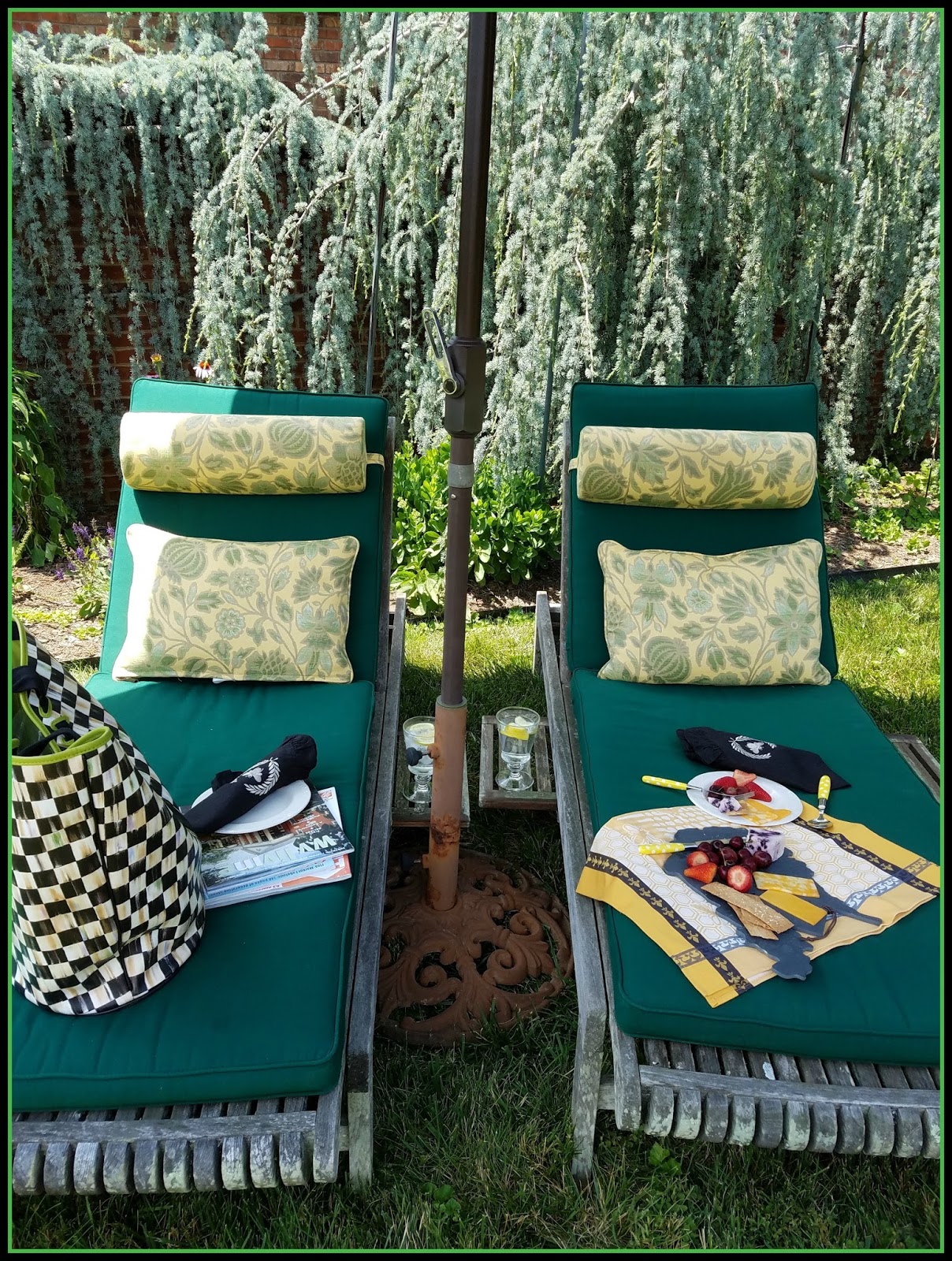
Raising the umbrella and pulling out the cushions for the chaise lounges makes for a comfy area in the garden, even when the sun is high in the sky.
Packing my tote - Miss Luna C - with a stack of magazines, a couple plates, napkins, and utensils, along with a few nibbles and serving slate promises a lazy afternoon of relaxed conversation, reading and noshing.
Checking out all the activity among the flower beds, or dozing off throughout the afternoon is my idea of practicing the art of doing nothing. You may have seen these napkins used in my Summer Place Setting tablescape. The bee theme is carried over to the water goblets (Sur la Table), and in the garden itself, among my many plants.
Easy snacks - cheese and crackers, fruit, and lemon water are simple, fresh and filling.
When the sun heads west, and the body and mind are nourished, I simply pack Miss Luna C with all my supplies and head back indoors.
It is truly a time of great satisfaction for me to sit in my garden, especially when sharing time with Mr. P. or other family member or a friend. Even in the middle of summer, just when I thought we were entering dogs days of repeatedly hot and humid days, we've gotten a few days of  respite with breezes and slightly cooler temps. It's just enough to carry us until fall. Simple pleasures!

The other gals of the traveling tote tribe have their own interpretation of putting their totes into service for their summer dining experience. Let's go see what they're up to, why don't we? All the links are conveniently listed below:
Debbie with Miss Aurora @ Mountain Breaths
Emily with Miss Courtney Childs@ The French Hutch
Jenna with Miss Coquille @The Painted Apron
Linda G with Miss Rosie @ More Fun Less Laundry
Linda P with Miss Lola @ Life and Linda
Patti with Miss Kenzie and Miss Taylor @ "Pandora's Box"
Rita with Miss Luna C @ Panoply (you are here!)
Sarah with Miss Merri Mac @ Hyacinths for the Soul
Just a reminder...don't forget to come back on September 1, when our tribe shares how we spent our summer months!


Friday, July 28, 2017

Changes in Latitudes, Attitudes

We took a little trip to Naples, FL in mid-July for a change in latitude, change in attitude.
Coal barges on the Kanawha in WV; Beach chairs on the Gulf in FL
It's the third year in a row we've been to Naples. As I've said before, it's the closest place we've found to where we consider our ultimate paradise in Grand Cayman, BWI. However, it is stateside, and there's really everything (and more) to do in Naples other than scuba diving, which we still enjoy.

Some of what we love about Naples includes the place we repeatedly stay, the Edgewater Beach Hotel.
Edgewater Beach Hotel, Naples FL
 Our daily walks on the beautiful shores early in the morning can't be beat.
Daily walks on the Gulf shore at Naples
Then, we would go shopping to beat the heat.

Beautiful displays of stores we don't have at home....
Gattles in Old Naples stocks Matouk linens and Juliska china
Some with items of whimsy that may have come home. ;)
Retail in Naples includes Zazou stocking MacKenzie-Childs; Pottery Barn; and the Best of Everything which stocks good hostess gifts, souvenirs and apparel, accessories.
Around and about town, I saw various signs that caught my eye.
Signage in FL - some serious, some whimsical. Life preservers are free for use on the Naples public shore.
And from the water, we toured houses that we can't afford to buy.
Boat tour with Capt Max around Port Royal included seeing: the Honorable Judge Judy's and musicians' Rick Springfield and Jon Bon Jovi homes
Naples' Collier county landscapes abound with species tropical that easily compete with Palm Beach's, Broward's or Dade's.
Notable landscaping in Naples
But did you know in Naples they also grow mermaids??
Mermaid in Naples!
Yes, it's a rare species, that mermaid, not like the many other birds and sea creatures we saw daily!
Birds of a feather, crab, and feathery moss on Naples' Gulf shore
Just as the birds on which we would come upon would fly, we too had to say our goodbyes.

From over sea and back over land, it's ta-ta for now, until we see Naples again.
View from plane: above the clouds and over the sea; over the land (that's our plane's shadow)
If you'd like to read more about our first impression and experience in Naples, you can read this post.

We three Panoply sisters are getting together this weekend, and have a fun-filled agenda. We'll be checking out a new-to-us town for some vintage shopping, maybe an estate sale, and are planning to go to a revived, 200 year old local salt farm for a farm-to-table dining experience. We had rain all day yesterday, and it's supposed to continue through today, making way for some perfect weekend weather with cooler temps. You know what that means....thinking of what's soon to come....
Thanks for your visit! Feel free to leave your comments.
Rita C. at Panoply

Monday, July 24, 2017

Weeping Cedar Atlas Plant - Garden Specimen Plant

Whether you've planned a garden from scratch or just planted things disregarding any plan, one thing sure to make you happy in the garden is having some sort of specimen, or focal, plant. Sure, there are other types of focal points in the garden that are great to have, but I'm talking about the kind of eye-catching, show-stealing star of your garden's plantings. It may be a flowering plant, it may be a tree, it may have year-round interest, or may be a short display in one season.
Many of you made mention of a particular plant in my garden in my Mid-Summer Garden Blooms, Views post from the photo I shared (below). This plant - a weeping [blue] cedar Atlas - was purposely chosen as a garden specimen, or focal, plant, with the future growth characteristics in mind when we planted it in 2004. Today's post is all about that shining star in my garden, and how it's changed over the last 13 years.
The weeping blue cedar Atlas' preferred USDA hardiness growing Zones are 6-9. This and other weeping blue cedar Atlas plant facts are summarized at the end of this post. Below is a photo of how our weeping cedar Atlas appeared nine months after being planted (August, 2005). In 2004, our area was USDA hardiness rated as Zone 6b; in 2012 it was rezoned as Zone 7a. There is a single stake supporting the plant, and a few strategic anchors in the brick wall. Notice the sinewy, snaking trunk, a feature of this specimen that only gets better with age.
The photo below puts our original landscape garden into perspective. The weeping cedar Atlas is on the left side of the frame below (The Japanese maple planted just beyond the weeping cedar looks like a bush. The mature, very tall and colorful tree in the background is our sassafras, growing on the riverbank across the street.). Look at all that space in the garden among plantings. This is an example of avoiding a very typical pitfall of many who do plan/plant gardens. We planned for the maturity of the plants and space needed in our landscape garden plantings to avoid wasting money having to necessarily pull plants within just a couple years as a result of overgrowth.
I said in my previous garden post it is very hard to capture the weeping cedar Atlas in its entirety, as it now spans over 24' across the brick on the west side of our garden wall. I stood on a bench inside our courtyard, about 50' away, to get it all in the lens. This is our weeping blue cedar Atlas, nearly 13 years after the original planting. The draping, twisting branches are one of its noted features.
The main trunk of the weeping cedar Atlas has also grown in thickness. The photo below was taken in 2015, as seen from standing in front of the plant. The sinewy trunk is even more outstanding now, with an obviously more burly appearance than when first planted.
The photo below is a trunk shot taken this year (2017), as seen from underneath, behind the draping growth. It resembles a snake the likes of an Anaconda python, doesn't it?!
Another shot, as taken from below/behind, looking upward, with the brick supporting wall at the top of the frame. This shows the branches above and beyond the main trunk. Yes, I was totally crouched beneath to get the shot.
The following photo shows the profile of the plant. Notice the Japanese maple behind the weeping cedar. When comparing this shot to the one above showing the original planting, it's pretty amazing to me every time I review the then and now photo. We limit our plant to within the depth of the mulch bed, not to extend into the lawn (or much behind the wall).
The photo below is how the weeping cedar appeared in the winter of 2014. This shot demonstrates the year-round seasonal beauty of our specimen plant. Snow on the branches really defines its shape! The branches to the far right only extended to the top edge of the frame at that time, and now they touch the mulch in the ground below (compare to the full-length photo earlier in this post). I can count five different stakes standing vertically along the plant, supporting and training its growth. The stakes, in some cases, now consist of 1" galvanized pipes with t-fittings in order for the branches to better cascade.
The detailed photo below shows the cones of the weeping cedar atlas. This is as large as they get, about 1-2 inches maximum. They are unnoticeable when they fall in the mulch, not sticky, sharp or harmful to pets. They simply turn brown and decompose into the mulch.
Here are the facts about the weeping blue cedar Atlas plant:
  • Latin, scientific name is Cedrus Atlantica 'Glauca Pendula' - part of the pine family
  • Common names are weeping blue cedar Atlas, weeping blue cedar, weeping Atlas cedar, weeping cedar Atlas, weeping cedar
  • USDA preferred hardiness Zones 6-9
  • Best in full sun - is drought resistant after getting established, low maintenance.
  • Does well in most types of soil, but acidic/loam soil is best. Needs good drainage. 
  • No significant pest or disease issues but should be placed in area protected from strong winds.
  • Mature growth is typically 10' high and 15-20' wide. Actual size will depend on how you train it to span and drape. If you don't train it upright early, it will grow low to the ground.
  • Foliage is powdery blue needles, cones in spring/summer.
  • Pruning should be done in dormant season (late winter) to train (no more than 1/3 of plant). Fertilize (I use Hollytone) in spring.

I mentioned when we planted this evergreen we gave forethought to avoiding the pitfall of not allowing enough space for our specimen weeping cedar Atlas to mature. To read more of those pitfalls to avoid when planning a landscape garden, see my post titled Landscape Plan: Lessons Learned, Pitfalls to Avoid

Do you have a specimen or focal plant in your garden? Are you thinking about planting one? Fall is a great time to plant. I am a non-revenue producing blog, but I would recommend this link from Monrovia Plant Catalog to help you choose a specimen (or any other particular type) plant for your garden. Under the 'Landscape Use' selection, you can choose specimen. You can also modify the results with other categories specific to your area to find what works. Good luck!

Thanks for your visit. and I'd love to hear your comments, or you can email me anytime.
Rita C. at Panoply